https://en.wikipedia.org/wiki/Prehistory_of_Transylvania#Periam-Pecica/Mureș_culture
Geto-Dacians
The
Helmet of Coțofenești – a full gold
Geto-Dacian helmet dating from the first half of the 4th century BC, currently at the
National Museum of Romanian History
In contrast to the heterogeneity of the preceding ages, the first Iron Age is remarkable for its homogeneity, which is the result of the emergence and generalization of a new culture displaying black ceramics ornamented with grooves. This cultural homogenization in the First Iron Age (1000-400 BC) represents essentially the material proof of the constitution within the Carpathian Danubian space of the early Geto-Dacians, who are culturally distinguishable from the southern Thracians and the other neighboring peoples. We are told this by the father of history himself—Herodotus. Recounting the Persian king Darius' expedition to the mouth of the Danube in 514 BC he mentions the Getae, praising them for their valour.[dubious – discuss]
Over 600 sites are known so far across the territory of Transylvania from the First Iron Age. Most sites were occupied during all stages of this epoch. Twenty-six fortifications, some inhabited permanently, others used for refuge and defense in times of peril, are among the more remarkable.
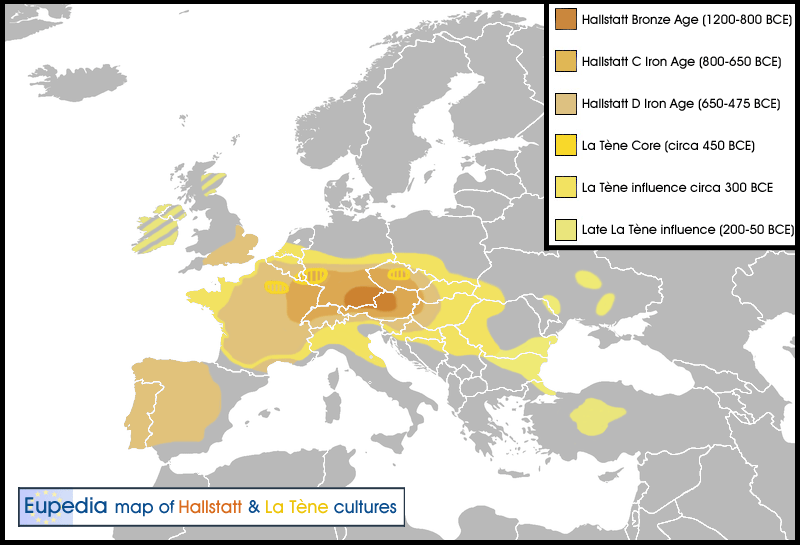
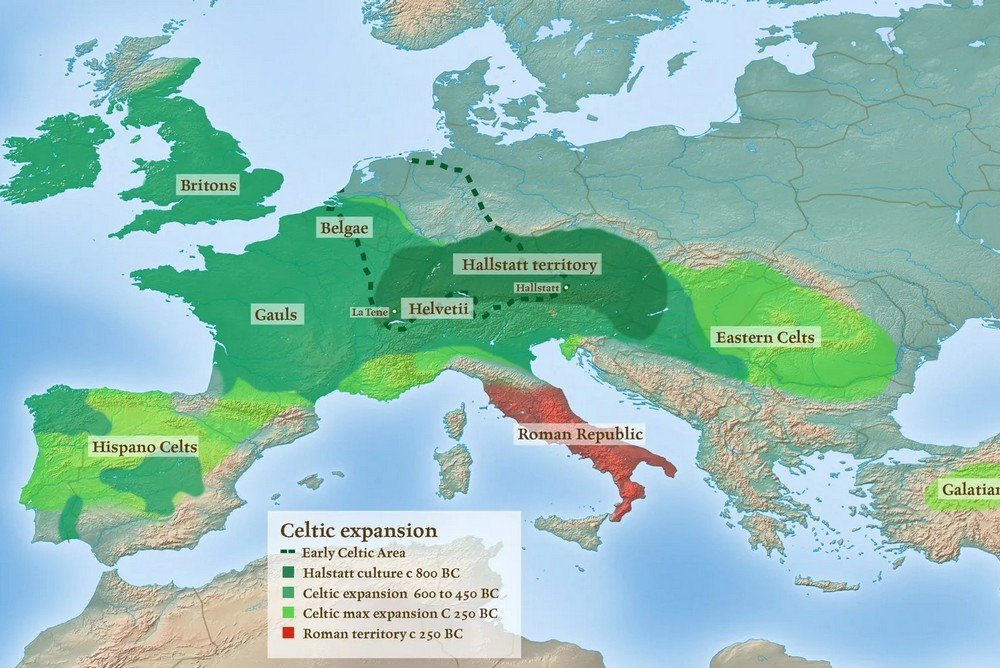
The First Iron Age period, also called the Hallstatt (after the finds in the locality of Hallstatt, Austria) covers the 10th to 5th centuries BC (1000-400 BC) and is divided into three periods: early (1000-700 BC), middle (700-600 BC) and late (600-400 BC). The Second Iron Age, also called La Tène, generally covers the period between 450 BC and the peak of Roman Empire.
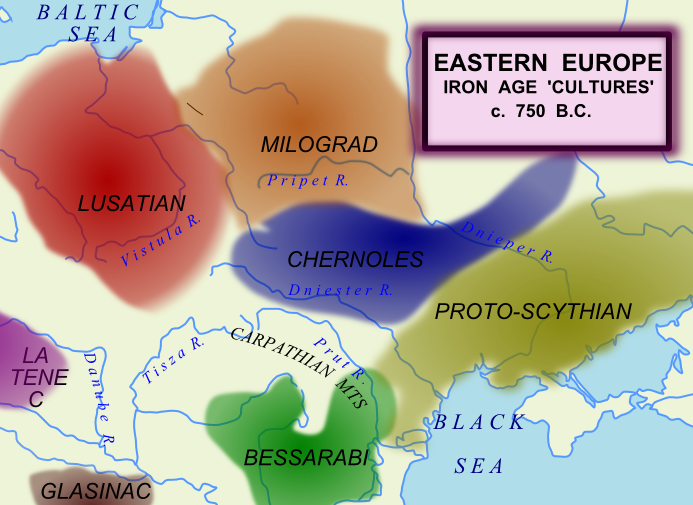
During the First Iron Age, the local culture was influenced by neighboring areas. Midway through the epoch, on the middle course of the Mureș there arrived from Banat elements of a culture called Basarabi. Displaying ceramics with specific decorations (incised and impressed), the culture was assimilated by the autochthonous background.
Subsequently, at the beginning of the late period of this epoch (6th century BC), a group of Scythian-Iranian extraction came into Transylvania from the direction of the North-Pontic. This group is marked by a series of inhumation graves with a typical inventory: arrow heads, lances called akinakai, and animal art representations. Research shows that in about the mid-5th century BC this group disappears through assimilation into the local culture. Actually, the end of the century also delimits the First Iron Age. During the following centuries the Geto-Dacians would attain a level of development that would lead them to form a state.
https://en.wikipedia.org/wiki/Basarabi_culture
The Basarabi culture was an archaeological culture in Southeastern Europe (mainly in Romania), dated between 8th - 7th centuries BC. It was named after Basarabi, a village in Dolj County, south-western Romania, nowadays an administrative component of the Calafat municipality. It is sometimes grouped with related Bosut culture, into the Bosut-Basarabi complex.
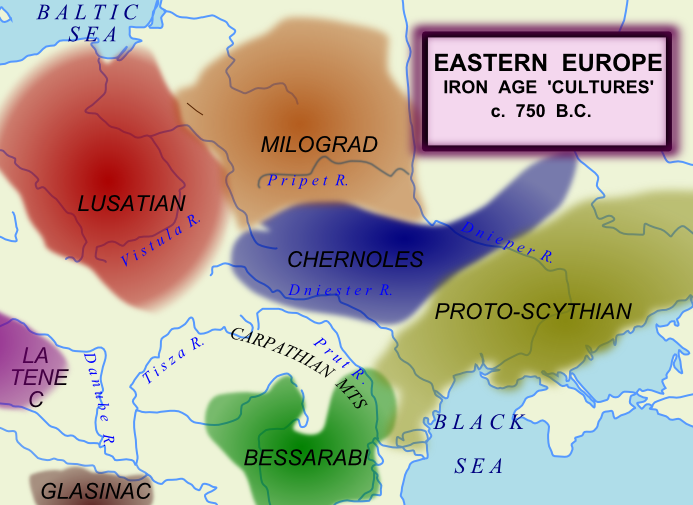
The Basarabi culture is related to the Hallstatt culture of the Iron Age period that, when normalised, is uniformly spread apart from a reduced number of sites in Muntenia, the central Moldavian Carpathians and Oltenia.
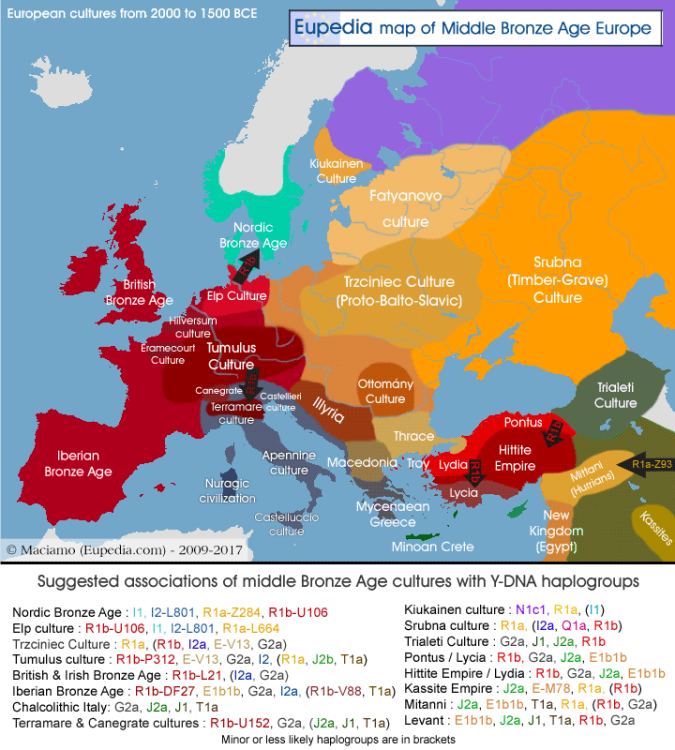
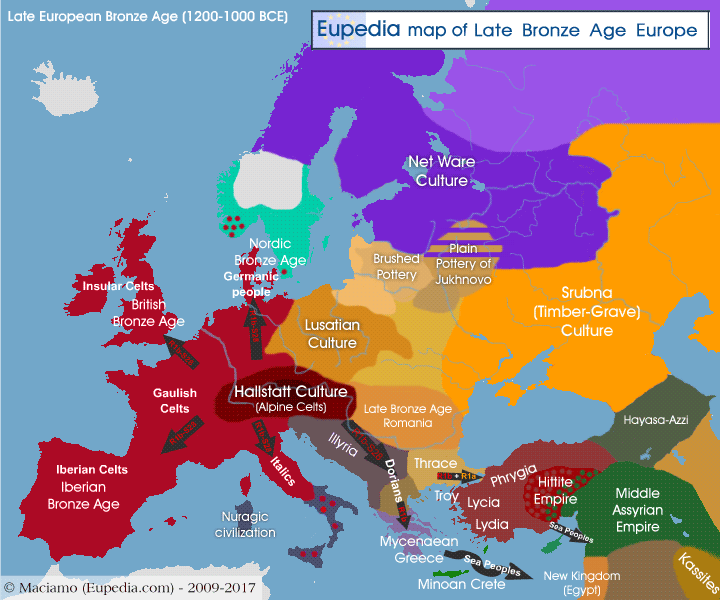
The Hallstatt A (12-11th BC) and B (10-8th BC) correspond to the late Bronze Age Urnfield culture, Hallstatt C (7th BC) to the early Iron Age, and Hallstatt D (6th BC) to the Iron Age. The Hallstatt culture probably consisted of many different peoples and language groups. The variant known as the Basarabi culture was present over much of Romania, Bulgaria, Serbia (Vojvodina), and central Moldavia up to the Dniester River (Nistru in Romanian) around 650 BC.
https://en.wikipedia.org/wiki/Dacia
(Peloponnesian Wars, Book II: "[Getae] border on the Scythians and are armed in the same manner, being all mounted archers").[2] Some historians argue that Daxia (mentioned in 3rd century BC) was the previous home of Indo-Iranian nomads[3] who later came to form the Geto-Dacian people.