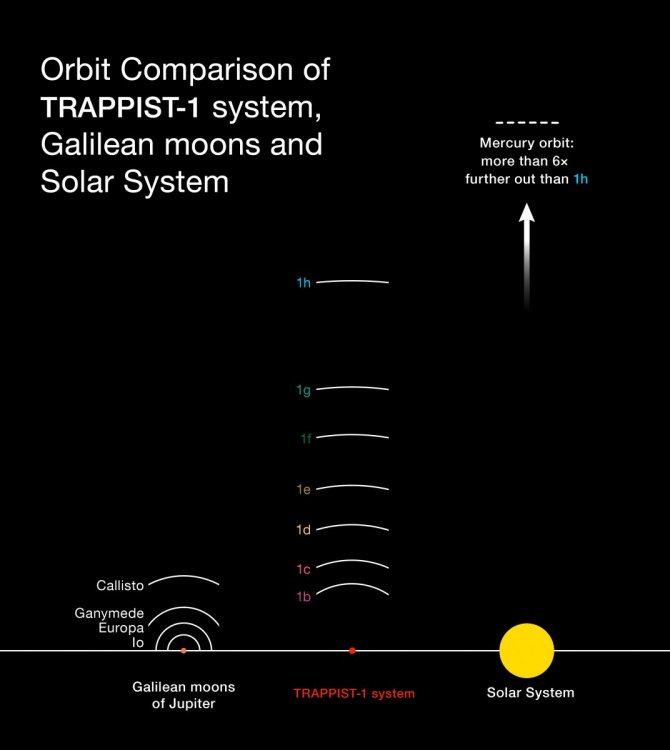
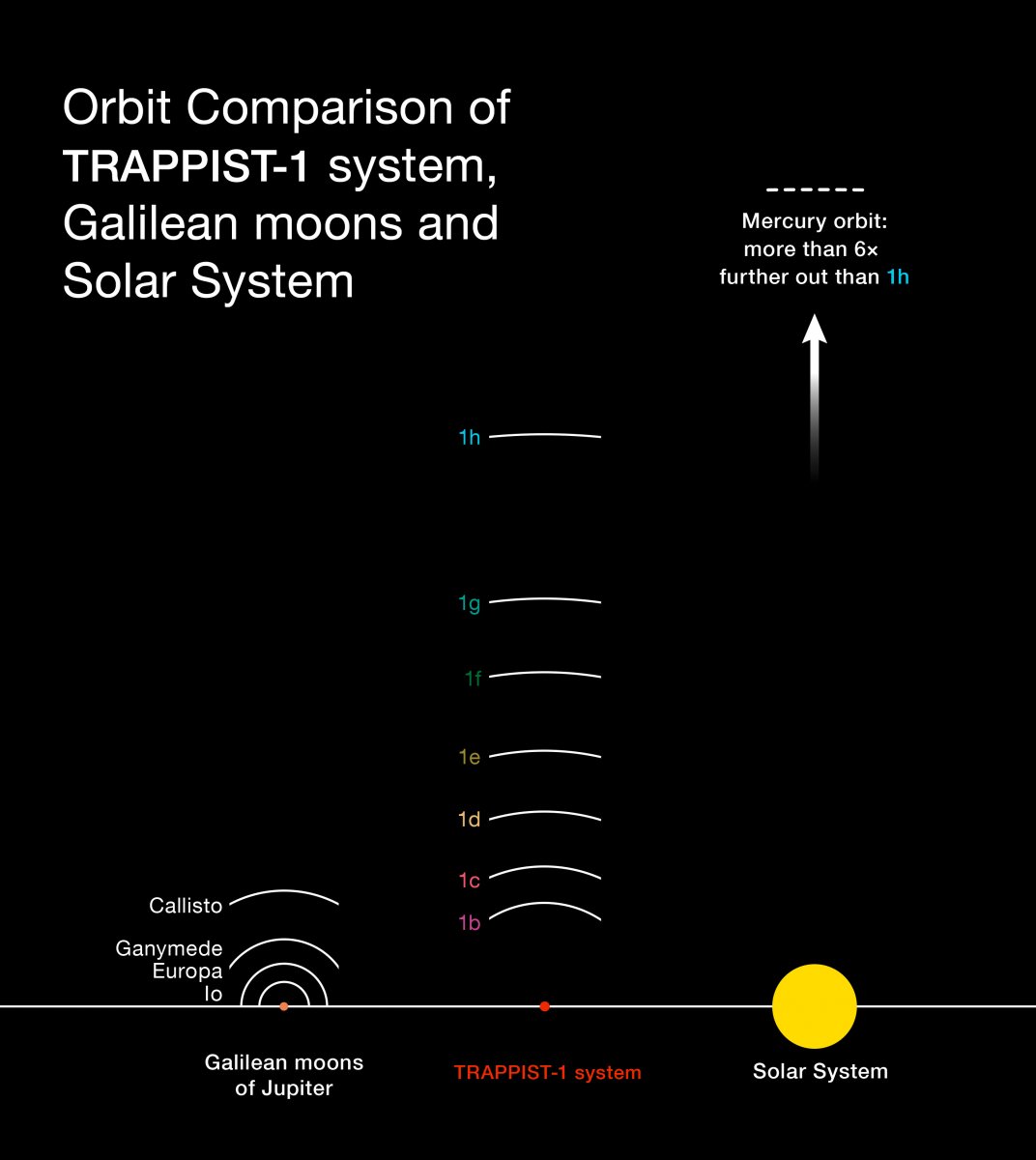
Intorcandu-ne la planetele din jurul stelelor pitice rosii, putem spune ca aceste planete sunt iradiate puternic de campul magnetic stelar, mult mai puternic decat cum o face campul magnetic jovian cu lunile sale.
Recently, four additional Earth-mass planets were discovered orbiting the nearby ultracool M8 dwarf, TRAPPIST-1, making a remarkable total of seven planets with equilibrium temperatures compatible with the presence of liquid water on their surface. Temperate terrestrial planets around an M-dwarf orbit close to their parent star, rendering their atmospheres vulnerable to erosion by the stellar wind and energetic electromagnetic and particle radiation. Here, we use state-of-the-art 3D magnetohydrodynamic models to simulate the wind around TRAPPIST-1 and study the conditions at each planetary orbit. All planets experience a stellar wind pressure between 103 and 105 times the solar wind pressure on Earth. All orbits pass through wind pressure changes of an order of magnitude and most planets spend a large fraction of their orbital period in the sub-Alfvénic regime. For plausible planetary magnetic field strengths, all magnetospheres are greatly compressed and undergo much more dynamic change than that of the Earth. The planetary magnetic fields connect with the stellar radial field over much of the planetary surface, allowing the direct flow of stellar wind particles onto the planetary atmosphere. These conditions could result in strong atmospheric stripping and evaporation and should be taken into account for any realistic assessment of the evolution and habitability of the TRAPPIST-1 planets.
https://iopscience.iop.org/article/10.3847/2041-8213/aa79ed
Red dwarfs also have much stronger magnetic fields than the Sun, which means that a habitable planet around a red dwarf is exposed to intense magnetic activity. This can heat the planet and even erode its atmosphere.
Tiny Red Dwarf Star Has a Magnetic Field Several Hundred Times Stronger Than Our Sun.
https://scitechdaily.com/tiny-red-dwarf-star-has-a-magnetic-field-several-hundred-times-stronger-than-our-sun/
But because a red dwarf is so cool, a planet would have to orbit very close to the star to be warm enough for liquid water to exist. That proximity would put the planet right in the bull’s eye for radiation that could strip its atmosphere or destroy any complex molecules on its surface.
What’s more, the emission from this star is 10,000 times brighter than what our own Sun produces, even though it has less than one-tenth of the Sun’s mass.
In concluzie nu ne-am dorii sa traim pe aceste planete din jurul stelelor pitice rosii din cauza radiatiilor nocive extrem de puternice din campul magnetic stelar si in al doilea rand datorita luninii slabe de la suprafata acestor lumi, comparabila cu o zi foarte noroasa si inegurata fie cu o zi la asfintit si aceasta daca planeta nu ar fi acoperita de nori altfel ar fi bezna completa.
Mult mai atractive sunt in acest sens stelele luminoase din clasa Soarelui: Alfa Centauri A si B, Sirius A, si Tau Ceti.