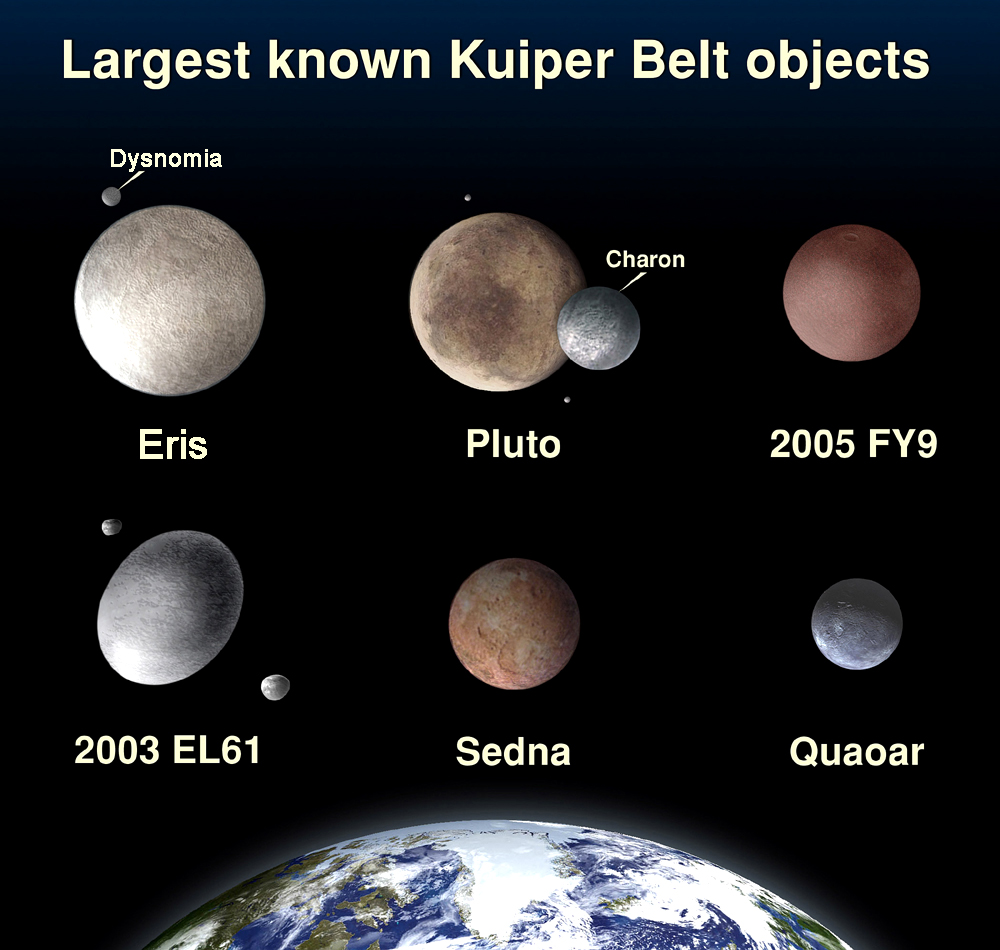
Pai sa le luam pe rand: in primul rand planeta Nibiru in cultura sumeriana nu exista decat in imaginatia lui Sitchin.
Planeta UB313 sau Eris face parte din sistemul nostru solar, deci nu are cum sa se apropie de el, din moment ce este inclusa in el, ca altfel s-ar plimba aiurea prin spatiu. ;)
Atasez o poza cu orbita planetei determinata de astronomi, ca sa nu mai creada si altii ca ar putea trece printre Marte si Jupiter :cry:

si uite de pe wikipedia despre orbita ei:
Orbit
The diagram illustrates the orbit of Eris (blue) compared to those of Saturn, Uranus, Neptune, and Pluto (white/grey). The segments of orbits below the ecliptic are plotted in darker colours, and the red dot is the Sun. The diagram on the left is a polar view while the diagrams on the right are different views from the ecliptic.Eris has an orbital period of 556.7 years, and currently lies at almost its maximum possible distance from the Sun (aphelion). It will next reach perihelion, according to the best available data, on March 29, 2257.[20] Its last perihelion was in late July of 1700. At a distance of roughly 97 astronomical units, it and its moon are currently the most distant known objects from the Sun in the solar system apart from long-period comets. Its semimajor axis is 67.669 AU, its perihelion distance is 37.78 AU, and its aphelion distance is 97.56 AU. Approximately forty known TNOs (most notably 2000 OO67 and Sedna), while currently closer to the Sun than Eris, have greater average orbital distances.[21]
Its orbit is highly eccentric, and brings it to within 37.8 AU of the Sun (a typical perihelion for scattered objects), still safe from direct interaction with Neptune (at ~30 AU). For comparison, Pluto, like other plutinos, follows a less inclined and less eccentric orbit and, protected by orbital resonance, it can cross Neptune