
Prima planeta Alpha Centaury pe orbita circumbinara ar orbita in jurul celor doua stele A si B la o distanta de minim undeva la nivelul orbitei Pamantului ori chiar a planetei Marte, iar la maxim ar ajunge la distanta lui Jupiter ori chiar Saturn fata de cele doua stele. Totusi lumina celor doua stele ar crea o ecosfera utila chiar si la nivelul orbitei lui Jupiter si deci ar putea fi sanse de habitabilitate in conditii speciale.
Catalog de Sisteme Solare
Început de mudcrab, Sâm 30 dec 2017 · 63 răspunsuri · 7.440 vizualizări
Este foarte important ca planetele sau lunile unor planete, sa fie la distanta optima fata de steaua in jurul careia orbiteaza, ca sa poata sa fie "locuibila". Pentru acea distanta optima fata de stea trebuie tinut cont de gradul de luminozitate al stelei. Pentru a fi "locuibila", trebuie sa fie aer, sa aiba atmosfera, trebuie sa fie apa sub forma lichida si, oare ce-ar mai trebui?!
LuciaD a scris:Este foarte important ca planetele sau lunile unor planete, sa fie la distanta optima fata de steaua in jurul careia orbiteaza, ca sa poata sa fie "locuibila". Pentru acea distanta optima fata de stea trebuie tinut cont de gradul de luminozitate al stelei. Pentru a fi "locuibila", trebuie sa fie aer, sa aiba atmosfera, trebuie sa fie apa sub forma lichida si, oare ce-ar mai trebui?!
Există câteva elemente esențiale:
1. Apa
2. Aerul
3. Fraierul!

Vriies a scris:Există câteva elemente esențiale:
1. Apa
2. Aerul
3. Fraierul!
Nici chiar asa, ca este o intreaga filozofie si treaba cu "fraierul/fraiera"! S-ar putea ca, "fraierul/fraiera" sa nu fie asa cum se da impresia, uneori!
On: Asa cum am mai spus, apa sub forma lichida primeaza. Cu siguranta, sunt multe planete(sau luni ale lor) care au la suprafata lor "apa lichida" si cred ca, in curand(mai repede decat au prognozat ei - 15-20 ani ziceau), NASA va anunta acest lucru. Este opinia mea.
Editat Dum 21 oct 2018 21:45
https://en.wikipedia.org/wiki/Habitability_of_binary_star_systems
One study ofAlpha Centauri, the nearest star system to the Sun, suggested that binaries need not be discounted in the search for habitable planets. Centauri A and B have an 11 AU distance at closest approach (23 AU mean), and both should have stable habitable zones. A study of long-term orbital stability for simulated planets within the system shows that planets within approximately three AU of either star may remain stable (i.e. thesemi-major axisdeviating by less than 5%). The HZ for Centauri A is conservatively estimated at 1.2 to 1.3 AU and Centauri B at 0.73 to 0.74—well within the stable region in both cases.
For acircumbinary planet, orbital stability is guaranteed only if the planet's distance from the stars is significantly greater than star-to-star distance.
The minimum stable star to circumbinary planet separation is about 2–4 times the binary star separation, ororbital periodabout 3–8 times the binary period. The innermost planets in all the Kepler circumbinary systems have been found orbiting close to this radius. The planets havesemi-major axesthat lie between 1.09 and 1.46 times this critical radius. The reason could be thatmigrationmight become inefficient near the critical radius, leaving planets just outside this radius.[6]
For example,Kepler-47cis agas giantin the circumbinary habitable zone of theKepler-47system.
Deci circumbinare habitabile in Alpha Centauri nu exista, dar poate doua-trei planete in jurul fiecarei componente stelare ...
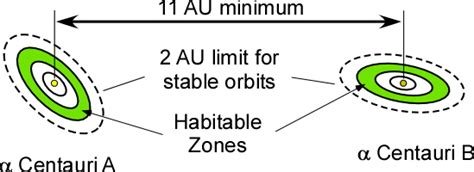
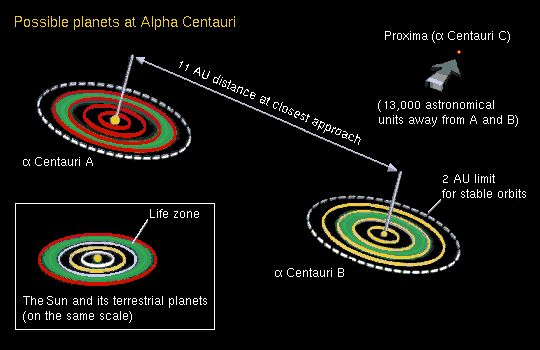
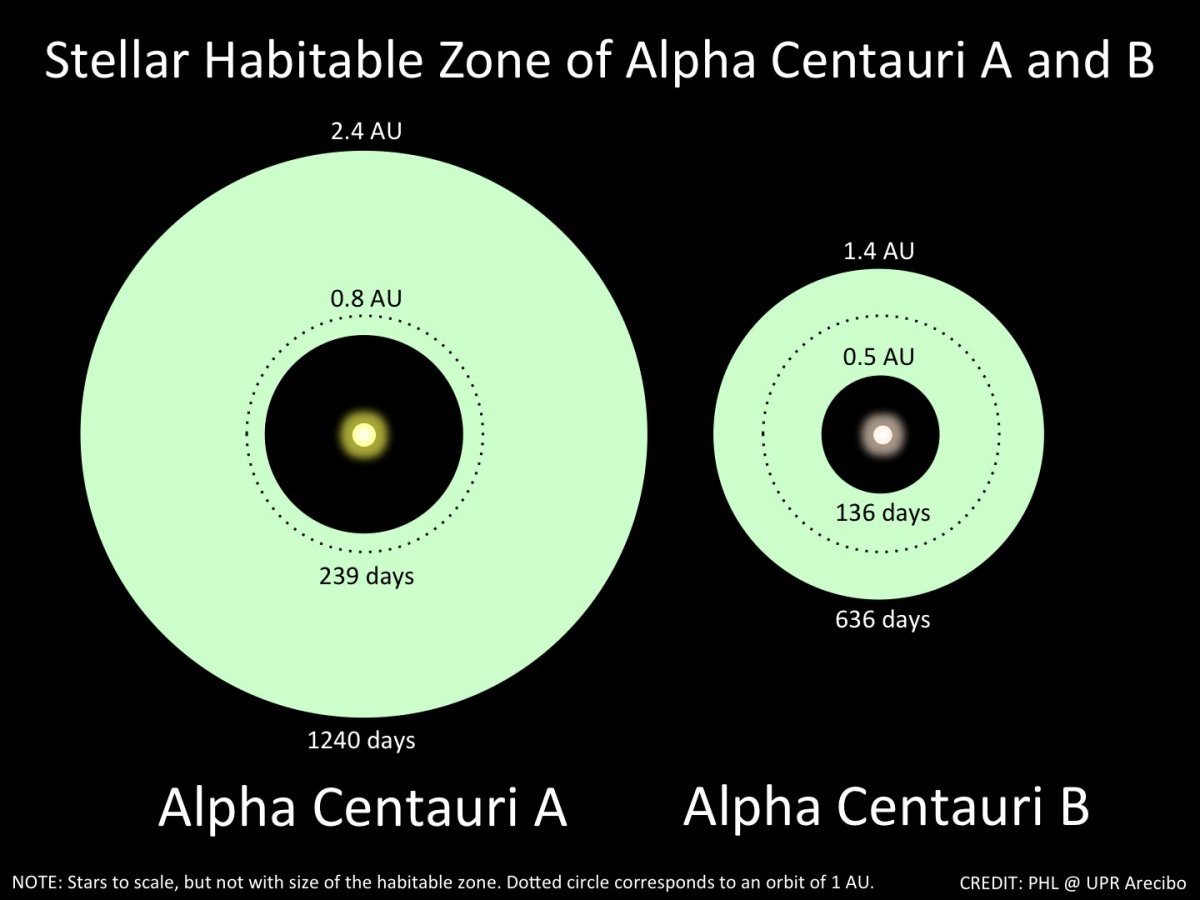
https://en.wikipedia.org/wiki/Habitability_of_binary_star_systems
https://en.wikipedia.org/wiki/Semi-major_and_semi-minor_axes
A study of long-term orbital stability for simulated planets within the system shows that planets within approximately three AU of either star may remain stable (i.e. thesemi-major axisdeviating by less than 5%). The HZ for Centauri A is conservatively estimated at 1.2 to 1.3 AU and Centauri B at 0.73 to 0.74—well within the stable region in both cases.
Ingeometry, the major axis of anellipseis its longestdiameter: aline segmentthat runs through the center and bothfoci, with ends at the widest points of theperimeter. Thesemi-major axisis one half of the major axis, and thus runs from the centre, through afocus, and to the perimeter. For the special case of a circle, the semi-major axis is theradius.
zod a scris:https://en.wikipedia.org/wiki/Habitability_of_binary_star_systems
https://en.wikipedia.org/wiki/Semi-major_and_semi-minor_axes
A study of long-term orbital stability for simulated planets within the system shows that planets within approximately three AU of either star may remain stable (i.e. thesemi-major axisdeviating by less than 5%). The HZ for Centauri A is conservatively estimated at 1.2 to 1.3 AU and Centauri B at 0.73 to 0.74—well within the stable region in both cases.
Ingeometry, the major axis of anellipseis its longestdiameter: aline segmentthat runs through the center and bothfoci, with ends at the widest points of theperimeter. Thesemi-major axisis one half of the major axis, and thus runs from the centre, through afocus, and to the perimeter. For the special case of a circle, the semi-major axis is theradius.
Frate, bagă și un picuț de limba română, plizzz!
Adica planetele alpha centauri pana la orbita lui Marte ar avea orbite rotunde cu excentricitate de 5%.
zod a scris:Adica planetele alpha centauri pana la orbita lui Marte ar avea orbite rotunde cu excentricitate de 5%.
Adică orbite „aproximativ rotunde”. 
Dar e ok. Pentru ca toți să înțelegem, să mai spunem că „excentricitatea” este o măsură a abaterii orbitei eliptice a unei planete sau unui satelit de la forma perfect circulară. Pentru o orbită perfect circulară excentricitatea este zero.
Bun, prin comparație, să ne aducem aminte că excentricitatea orbitei Pământului ar fi cam de 0.0167.
Problema este caci catalogul NASA nu cuprinde si sistemele binare, iar celalalt catalog nu are animatii ale sistemelor, orbitele si modelul comparat cu sistemul solar, deci va fi destul de greu de aflat mai multe sisteme binare comparate cu Alpha Centauri...
La modul general am observat ca orbitele planetelor si forma acestora poate varia foarte mult indiferent daca avem stele izolate ori binare, chiar regula se inverseaza adesea si stelele izolate par a avea mai multe planete cu orbite ciudate.